The visual workflow platform is dying. What comes next is better.

Strong claim. Let me back it up.
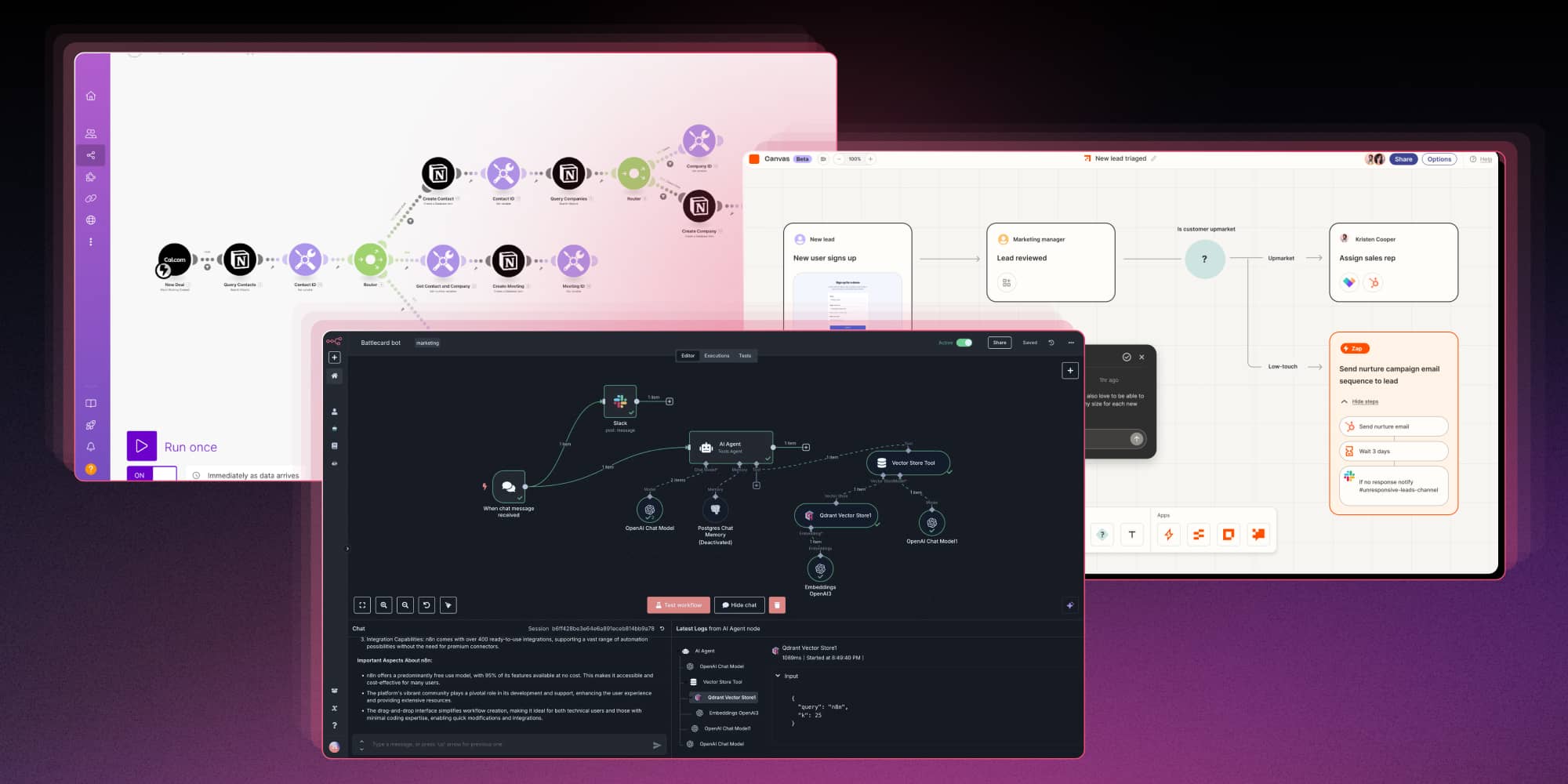
Zapier has 7,000+ integrations and millions of users. n8n recently raised $180 million at a $2.5 billion valuation. Make.com is profitable. By conventional measures, the visual workflow automation market has never been healthier.
And yet something is quietly breaking underneath it. The developers who were supposed to be the power users of these platforms are leaving. Not dramatically – they're not writing blog posts about it (well, some are). They're just reaching for LangChain, CrewAI, or plain Python instead. The forums are filling up with workarounds for things that should work. The Reddit threads about "when n8n is NOT the right choice" are getting long.
The market isn't dying. The paradigm is shifting. And the companies that understand the shift early will build better products for it.
What the data actually shows
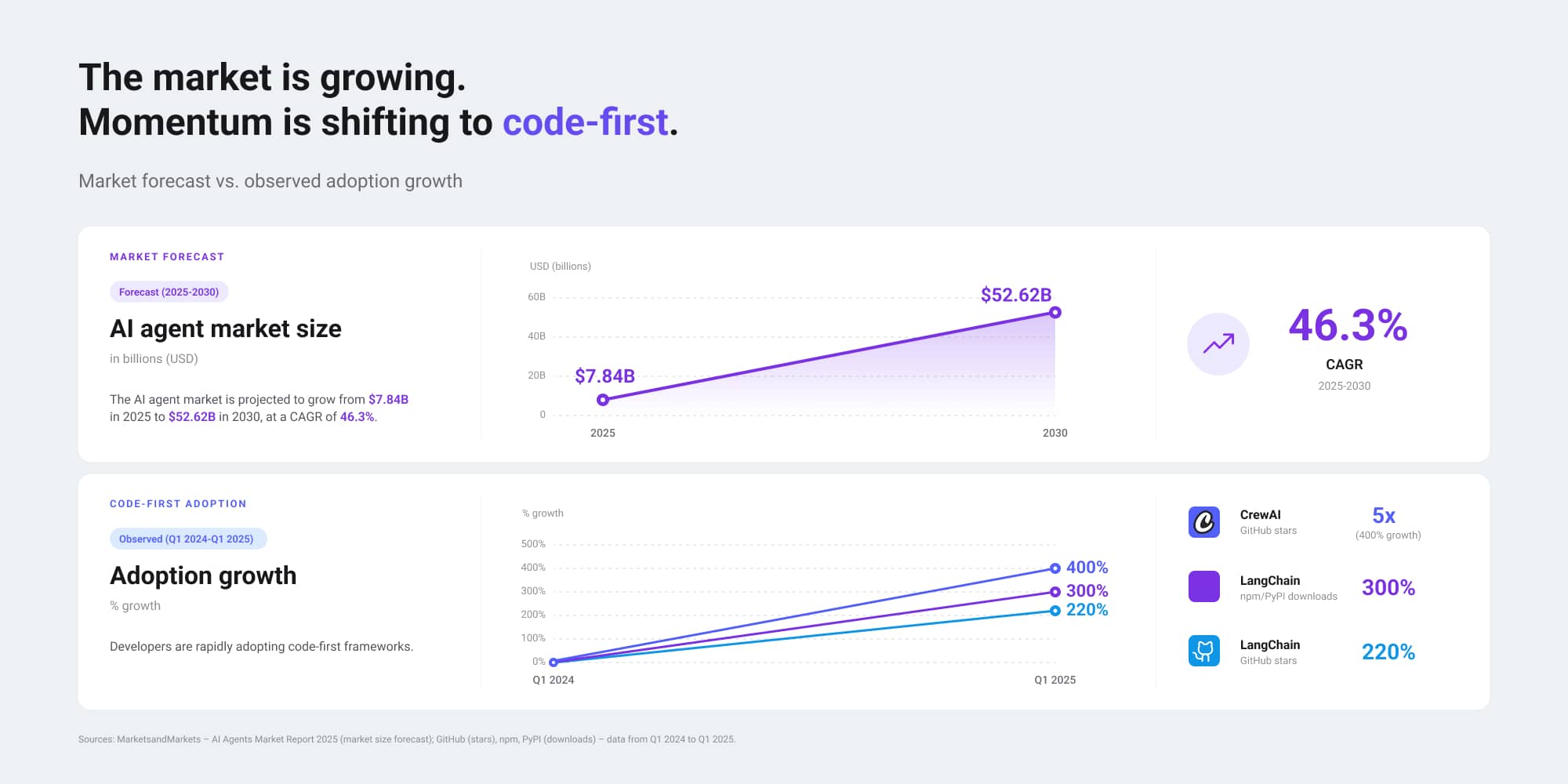
The AI agent market hit $7.84 billion in 2025 and is projected to reach $52.62 billion by 2030 – a 46.3% compound annual growth rate. AI startups captured $238 billion in venture funding in 2025, representing 47% of all global VC. n8n's ARR grew beyond $40 million with usage increasing 10x year-over-year.
This looks like a visual workflow automation boom. Look closer and it's something different.
LangChain – a code-first Python and JavaScript framework for building AI applications – grew GitHub stars by 220% and npm/PyPI downloads by 300% between Q1 2024 and Q1 2025. CrewAI grew GitHub stars 5x in 2025, raised an $18 million Series A, and is now running 100,000+ agent executions per day, with 60% of Fortune 500 companies using it. LangGraph Platform has approximately 400 companies running it in production, including Cisco, Uber, LinkedIn, BlackRock, and JPMorgan.
These are not users who couldn't figure out Zapier. These are engineering teams who chose code over visual platforms deliberately – and are building AI systems at enterprise scale on top of that choice.
The LangChain State of Agent Engineering survey, published in December 2025 with 1,340 respondents, found that 57.3% of organizations have AI agents in production, up from 51% the year before. The majority of those agents are running on code-first frameworks, not visual platforms.
Why developers are leaving visual platforms
The frustration is documented, specific, and consistent across communities.
Zapier imposes a 30-second execution limit per task and a 256MB memory cap. There's no Git integration – workflows can't be version-controlled, reviewed in pull requests, or rolled back like code. Billing penalizes scale: as automation volume grows, costs grow in ways that make unit economics painful for product teams building automation into their products.
n8n's community forum contains an official thread titled "When N8N is NOT the Right Choice for AI Automation." The documented issues include crashes when processing more than 100,000 rows, no native version control for workflows, and what developers describe as the tool "starting to feel clunky once you're doing actual agent logic." A widely-discussed Reddit thread titled "Why I Left n8n for Python" documented five specific failure modes: file handling limitations, unpredictable performance at scale, painful debugging for complex logic, node limitations that force awkward workarounds, and reliability problems with AI agent state management.
Composio, a developer tools company, published an analysis on Dev.to that captured the structural problem directly: "There's a fundamental mismatch between workflow automation and agentic execution." Visual platforms were designed for deterministic, linear automation – trigger, action, result. AI agents are non-deterministic, stateful, and require error handling and retry logic that visual platforms weren't built to express.
The shift that's actually happening
Here's the insight that the venture capital narrative misses: developers aren't rejecting visual interfaces. They're rejecting visual platforms that control both the logic and the interface.
The separation that's happening is architectural. Developers want to write agent logic in code – Python, TypeScript, LangGraph, CrewAI – where they have version control, testability, composability, and the ability to handle complexity without workarounds. But the end users of the systems they're building still need visual interfaces. A marketing operations team running AI-powered campaign workflows needs to see and modify those workflows visually. An underwriting team at an insurance company needs a visual interface for the claims processing logic that developers built in code.
Microsoft's Azure Architecture Blog now officially describes a "Workflow-First vs Code-First vs Hybrid" decision framework, recommending visual builders for simple flows and code-first for complex logic. Gartner projects that by 2026, 40% of enterprise applications will incorporate AI agents – applications that will need embedded visual editors their users can interact with. The embedded iPaaS market grew from approximately one vendor in 2019 to roughly 40 vendors in 2025, as SaaS companies realized their users wanted workflow UI inside their product, not in a separate tool.
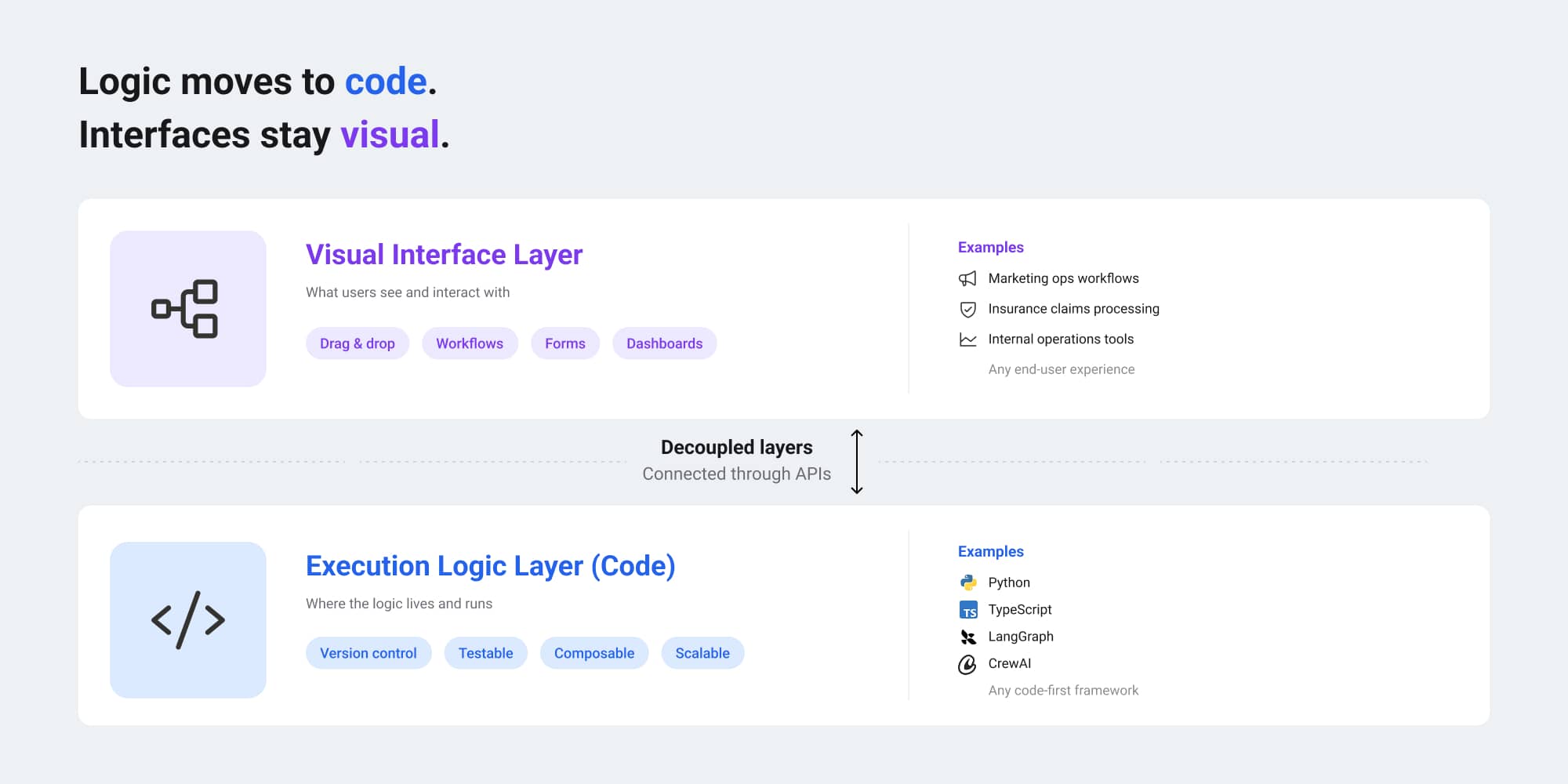
The pattern is consistent: logic in code, interface as an embedded component. The two layers are decoupling.
The emerging architecture
What this shift produces is a new architectural pattern that's becoming standard for AI-powered SaaS products:
The execution layer lives in code. LangGraph, CrewAI, custom Python, Node.js – whatever the team uses. It's in the repository, version-controlled, tested, deployable. It handles the actual agent orchestration, the state management, the error handling, the retry logic.
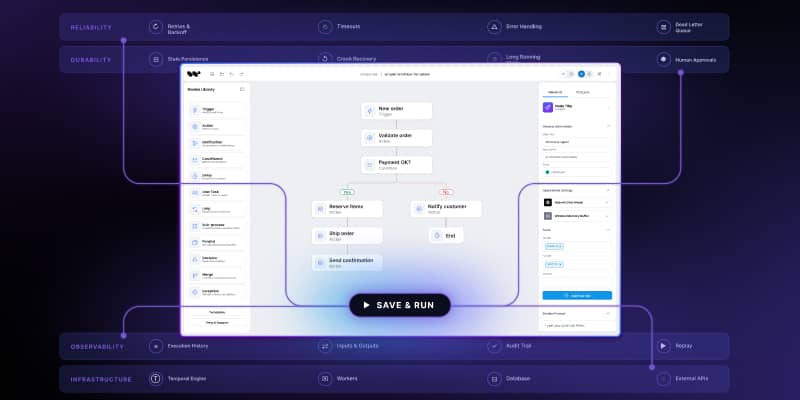
The visual layer is an embedded component. It sits inside the SaaS product, under the product's brand and design system. It lets users build, modify, and understand workflows visually. It exports to and imports from the execution layer's format. It's frontend-only – no separate server, no platform dependency, no recurring platform fees.
This architecture doesn't exist in Zapier. It doesn't exist in n8n's embed offering (which costs approximately $50,000 per year and hands you n8n's UI rather than your own). It doesn't exist in LangFlow or Dify or ComfyUI – powerful tools, but standalone products that aren't designed for embedding inside someone else's SaaS.
The companies that figured this out early are building moats. Braze Canvas, HubSpot Workflows, Salesforce Flow – the major SaaS platforms that own their workflow UI are consistently cited as core product differentiators and retention drivers. Native integrations and workflow editors are a top-three buying criterion in B2B software deals. 63% of SaaS companies invest in integrations specifically for customer retention.
What this means for SaaS companies building in 2026
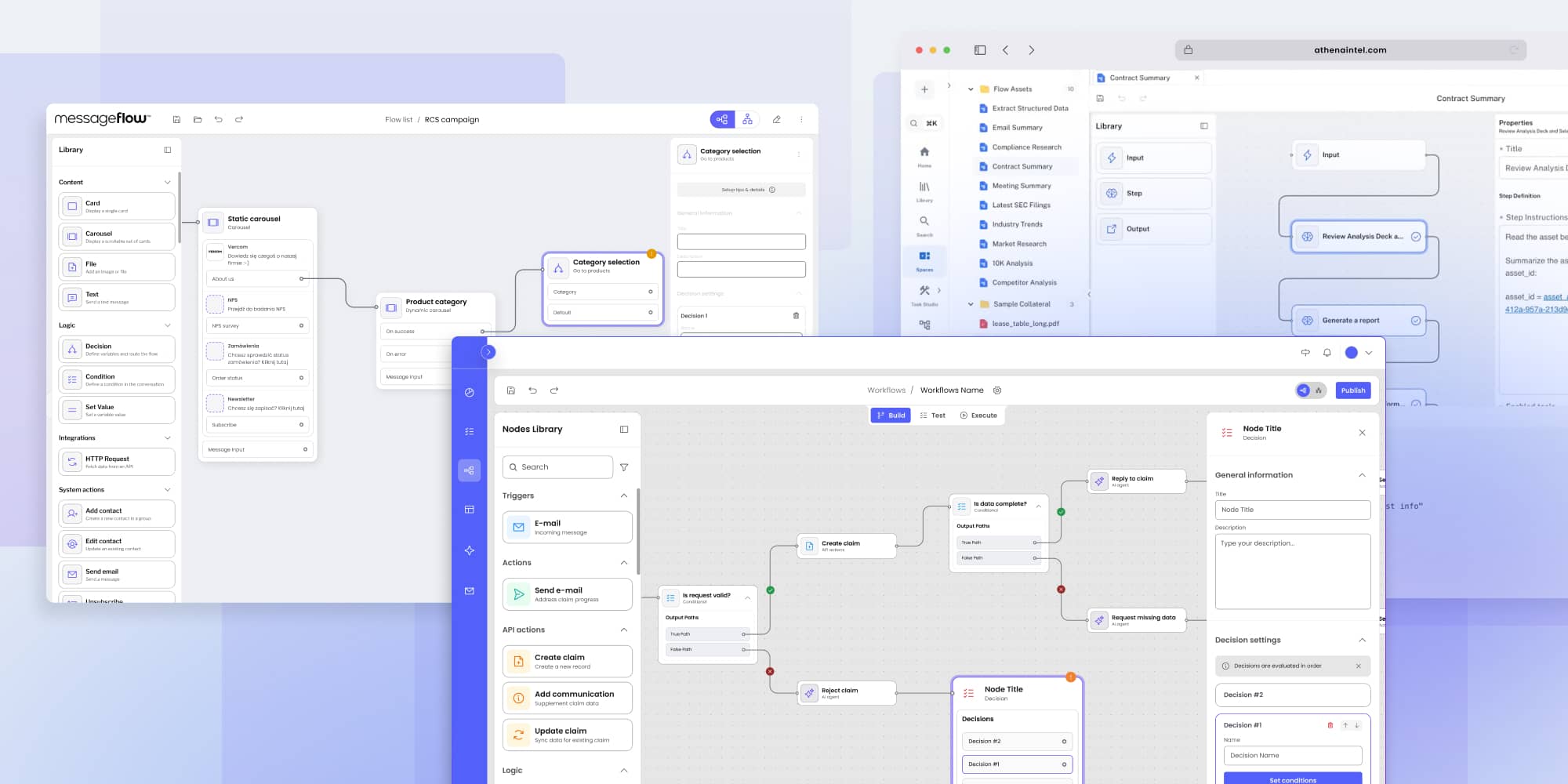
If you're building a SaaS product that involves any kind of workflow, automation, or AI agent logic, the question is no longer whether to add a visual workflow interface. The question is which layer you own and which you outsource.
Outsourcing the execution layer to a platform means vendor lock-in at the most critical part of your product: the logic. Outsourcing the visual layer means your users see someone else's UI inside your product, and you have no control over how that changes over time.
The architecture that's winning – in the Vercom projects, in the Keylane insurance deployments, in the Athena Intelligence AI orchestration work – is code-first execution with an embedded visual editor. The developers own the logic. The users get the interface. The two layers are cleanly separated.
That's not a niche architecture. It's where the market is going. The $52 billion AI agent market by 2030 will be built on it.
Workflow Builder is an embeddable workflow editor SDK by Synergy Codes — the team behind 100+ commercial diagramming projects for Siemens, BMW, Canon, and others. Open-source available or one-time license €6,990 for Enterprise Edition. React-SDK workflowbuilder.io
An entrepreneur and tech enthusiast, with over 14 years of experience building innovative diagramming solutions and tools across industries. Our interfaces help technical and non-technical users make informed business decisions.
Articles you might be interested in
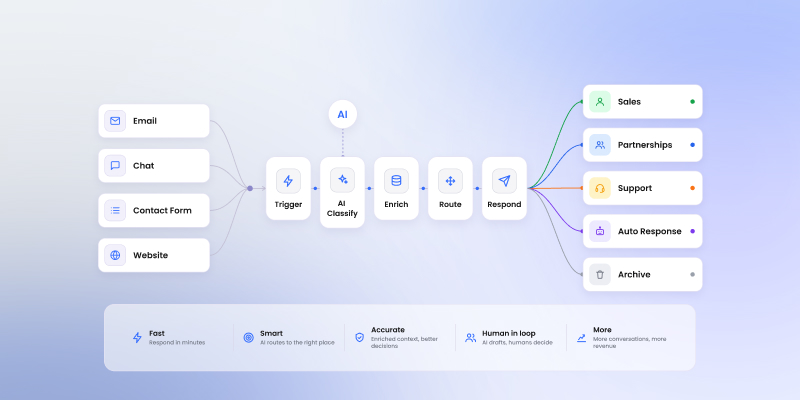
Sales inquiry AI workflow: a practical blueprint for routing and answering inbound requests
Inbound sales inquiries look the same on the surface and route to completely different teams. A five-step LLM workflow editor blueprint for classification, enrichment, and routing without the noise.