Best AI agent frameworks in 2026: a comparison for production teams

There is no single "best" AI agent framework for production in 2026—only the right architectural fit for your team's state requirements, human-in-the-loop (HITL) needs, and technology stack.
- LangGraph (Python/TS): Best for complex, branching state machines where state persistence and precise error recovery outweigh steep learning curves.
- CrewAI (Python): Best for fast prototyping and domain-friendly "team of specialists" abstractions using Crews (autonomous) and Flows (deterministic).
- Microsoft Agent Framework (.NET/Python): Best for enterprise .NET or mixed stacks needing unified, production-ready routing and HITL primitives (supersedes AutoGen).
- OpenAI Agents SDK (Python/TS): Best for lightweight, tool/handoff-driven agent loops, especially when paired with external runtimes like Temporal for long-running durability.
- Mastra (TypeScript): Best for JS/TS-native stacks needing built-in developer tooling, suspend/resume approval workflows, and tight Vercel/Next.js integration.
Ask five people which agent framework is "best" and you'll get five confident, contradictory answers… usually based on whichever one they shipped last. That's not because anyone's wrong. LangGraph, CrewAI, Microsoft Agent Framework, OpenAI Agents SDK, and Mastra aren't competing for the same job. AutoGen still belongs in the discussion, but as a maintenance note: Microsoft now directs new projects to Agent Framework.
Here's the comparison that actually matters for a production decision: not GitHub stars, but what happens when each framework hits real workloads, real failures, and real human-in-the-loop requirements.
LangGraph
Model: An explicit state graph: nodes and edges, with state passed and mutated at each step, and conditional edges that let execution branch or loop based on that state. As of 2026, LangGraph is positioned as a low-level orchestration framework focused on durable execution, streaming, human-in-the-loop, and stateful agents in its own right. It has maintained Python and TypeScript SDKs, and LangChain remains optional rather than structural.

Where it's strong: Checkpointing and state are first-class, not bolted on, which matters the moment a step needs to pause for a human and might not resume for hours. A recent, genuinely useful community test makes the case concretely: a developer built comparable pipelines on LangGraph and CrewAI, then deliberately broke a step midway through a nine-step workflow. LangGraph's checkpointing preserved state up through the last successful step and resumed the retry from there. The same failure on their CrewAI implementation caused earlier tasks to re-run, produced slightly different intermediate results, and changed the final output. CrewAI won the first hour. LangGraph won the moment something broke.
Where it costs you: That explicitness is a real tax, not a free upgrade. Developers building simpler agents have described the learning curve as steep relative to the task – designing state, nodes, transitions, and conditions for something that could have been a short script, and finding it hard to picture that model scaling cleanly to a graph with fifteen or twenty nodes.
That's not a reason to avoid LangGraph; it's a reason to be honest that the "extra work" the failure-injection test above rewarded is also the same work that frustrates people building something simpler.
Best fit: Agents with real branching complexity, loops, or long-running human-approval steps, where the cost of losing state on failure is meaningfully worse than the cost of more upfront design work.
A counterpoint worth taking seriously: not everyone agrees the state-machine metaphor is a net win. One vocal critic has argued that LangGraph's graph abstraction introduces indirection that a workflow doesn't necessarily need, in the same breath criticizing CrewAI's role-based framing as more of a narrative device for demos than a production-grade primitive.

That's a strong opinion, not a settled fact, but still a useful check: a framework's mental model can become a liability precisely when your actual application doesn't naturally fit it, and it's worth asking honestly whether your workflow needs a state machine before adopting one because it's the well-known option.
CrewAI
Model: Role-based multi-agent orchestration; agents defined as team members with roles, goals, and tools, coordinated toward a shared task. CrewAI has matured past a single execution style: it now offers Crews (higher-level autonomous multi-agent collaboration) and Flows (event-driven, more deterministic workflow control) as two distinct modes, which is a meaningfully more capable architecture than the framework's earlier "just agents with roles" reputation suggests.
Where it's strong: The mental model is the whole point, and it's a real product advantage. "Here's the researcher, here's the writer, here's the reviewer" is something a stakeholder who's never opened Python can understand in one sentence.
In one community head-to-head test, a developer had a two-agent CrewAI pipeline running in about 25 minutes, while the comparable LangGraph implementation took closer to two hours because its state and transitions had to be modeled explicitly.

Human-in-the-loop support has also caught up meaningfully. CrewAI 1.8+ ships a @human_feedback decorator that lets a Flow pause execution, collect feedback through either a flow-based or webhook-based model, and resume, with Enterprise tooling adding feedback management UI on top.
Where it costs you: The same abstraction that makes CrewAI fast to reason about can make fine-grained control harder once a task gets genuinely complex… as the failure-injection comparison shows, state recovery isn't where the framework's design effort has concentrated.
Best fit: Fast validation of a multi-agent concept, or production workflows where the "team of specialists" framing is a genuine match for the task, not just a convenient metaphor.
Microsoft Agent Framework
Model: A unified agent and workflow framework for .NET and Python, combining single-agent abstractions with graph-based and functional orchestration. Microsoft Agent Framework 1.0 brings together Semantic Kernel's enterprise foundations and orchestration ideas developed in AutoGen.

Where it's strong: It gives Microsoft-stack teams one supported framework across .NET and Python, with type-safe routing, conditional and parallel paths, checkpointing, human request/response steps, tool approval, and built-in multi-agent patterns. The workflow APIs cover both explicit graphs and a functional Python style.
Where it costs you: Version 1.0 is production-ready, but it is still a new consolidation. Existing AutoGen or Semantic Kernel teams need to account for changed APIs and concepts, and smaller applications may not need agents, workflows, middleware, and enterprise hosting from one SDK.
Best fit: .NET or mixed .NET/Python teams, organizations already invested in AutoGen or Semantic Kernel, and enterprise workflows that need explicit routing, checkpointing, and human approval.
AutoGen maintenance note
AutoGen remains usable for existing systems, but Microsoft's repository now marks it as maintenance mode and recommends Microsoft Agent Framework for new projects. Its conversation-driven model still fits dialogue-shaped tasks; the long-term trade-off is that new first-party features are going elsewhere.
OpenAI Agents SDK
Model: A lightweight agent SDK built around agents, tools, handoffs, guardrails, sessions, and tracing, available for Python and TypeScript.

Where it's strong: The surface area is deliberately small, so teams can start with one agent and add handoffs or approvals without adopting a separate workflow language. The Python SDK also has a documented Temporal integration for durable, long-running workflows, letting the SDK own the agent loop while Temporal owns recovery and long waits.
Where it costs you: It is not a graph-first workflow engine. Large predefined processes, custom recovery boundaries, and deterministic routing still need application code or an external durable runtime.
Best fit: Teams that want a small set of agent primitives, use tools and handoffs as the main coordination model, and are comfortable pairing the SDK with Temporal or another runtime when durability becomes a separate requirement.
Mastra
Model: A TypeScript-native agent framework, built for teams that want agent tooling without leaving the JS/TS ecosystem.
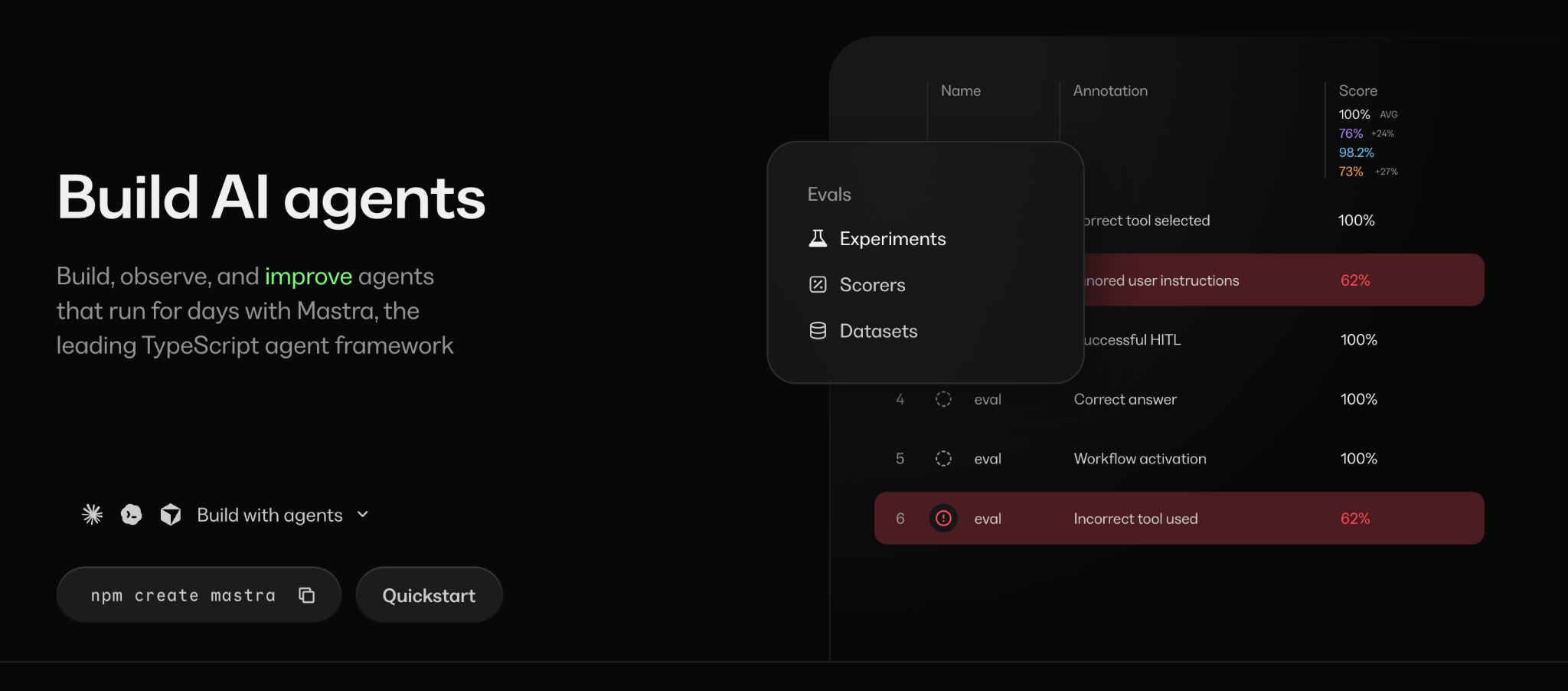
Where it's strong: Mastra's real advantage for a TypeScript product team is its batteries-included developer experience: agents, workflows, a local Playground, evaluation, and deployment tooling in the same stack. LangGraph also has a full TypeScript SDK, so the choice isn't about avoiding Python at all costs; it's about how much of the surrounding product experience you want assembled for you.
Language and application-stack fit can matter as much as a framework’s agent features. In one r/AI_Agents thread, a developer using Next.js and Payload CMS said they chose Mastra because it was TypeScript-based, could live inside the same application and deploy with the rest of the project on Vercel.

It's a stack-fit decision, and it's exactly the kind of criterion that a feature-matrix comparison misses entirely.
Mastra's human-in-the-loop support has also matured quickly and is genuinely more sophisticated than older comparisons give it credit for: Workflows support suspend/resume with persisted state, letting execution pause for an extended period awaiting approval or input before continuing; tool calls can require explicit approval; and as of early 2026, Agent Networks support resuming a network and approving or declining individual tool calls within it.
Mastra's own documentation draws a clean distinction between tool-level approval (stopping an action before a specific tool fires) and workflow-level approval (letting the workflow gather context and complete partial work before pausing ahead of a risky step) – a way more deliberate design than most frameworks bother to articulate.
Where it costs you: A newer and smaller ecosystem than the older Python-first options, with fewer battle-tested community patterns for edge cases. In June 2026, a compromised npm maintainer account was used to republish affected Mastra packages with a new dependency, easy-day-js. The malicious postinstall loader lived in that injected dependency, not in Mastra's repository code. The releases were removed, but teams that installed them needed to treat exposed environments as potentially compromised and rotate credentials. This is a supply-chain disclosure, not a recommendation against adoption, and it makes dependency pinning and package provenance part of the evaluation.
Best fit: TypeScript-first teams building agent features inside an otherwise all-JS/TS product, particularly where genuine human-in-the-loop control matters.
How teams migrate between these
Publicly documented company migrations between agent frameworks remain scarce. Most available evidence comes from individual developers and community discussions rather than formal architecture postmortems, so the patterns below should be treated as directional.
One recurring trade-off is the move from fast, role-based prototyping toward more explicit orchestration. Developers frustrated with CrewAI have cited routing problems, overlapping agent responsibilities and difficulty controlling execution order, while LangGraph users tend to value explicit state and transitions. That does not yet amount to strong evidence that CrewAI-to-LangGraph is the dominant migration path, and newer CrewAI Flows now cover more stateful and event-driven orchestration than early versions did.
A better-documented comparison involves AutoGen. In one workplace evaluation, a developer described AutoGen v1 as easier to use but harder to control, while LangGraph made the LLM’s execution cycles more explicit. This is one practitioner’s experience, not a representative migration study. AutoGen’s current maintenance status adds a separate long-term consideration: Microsoft says the project will continue receiving fixes and security patches but no significant new features, and recommends Microsoft Agent Framework for new projects.
A third path is to reject the available packages without rejecting graph orchestration itself.

One team said it had tested LangChain, LangGraph and the OpenAI Agents SDK extensively before building its own internal framework. It kept elements of LangGraph’s graph model, then added an async execution and streaming layer tailored to its own application. The example shows that the architectural concept and a particular framework’s APIs are separable.
What framework choice won't fix
It's worth naming a counterpoint the community keeps raising, because it cuts through a lot of framework-comparison hype: developers who've spent months running agents in production have reported that a large share of their real operational pain came from flaky external APIs and agents retrying failing calls – not from the orchestration framework itself. Picking the "right" framework doesn't fix an unreliable tool layer underneath it, and it's worth being honest that framework choice is one variable among several.
The other choice that isn't in this table at all: each framework hands you a graph, a crew, an agent loop, or a workflow that lives in code. Reading it, auditing it, or changing it after launch is still a developer's job by default. That's a separate decision from which framework fits your workflow – worth making deliberately rather than discovering eighteen months in, when someone who isn't a developer needs to see what the agent is doing and there's no way in that doesn't start with "let me check with engineering."
We go into that gap, and what a visual authoring layer on top of any of these frameworks actually requires, in our orchestration pillar.
- Is AutoGen still safe to use in production?
It remains functional, stable software, and teams with an existing investment in it aren't facing an urgent forced migration. What's changed is that Microsoft has placed it in maintenance mode – no new features, community-managed going forward – so any evaluation should weight that against frameworks under active development, especially for multi-year projects.
- Does LangGraph require LangChain?
No, as of current documentation. LangChain components appear throughout LangGraph's examples for convenience, but LangGraph is positioned as its own independent, low-level orchestration framework and doesn't require the LangChain dependency structurally.
- Which framework has the best human-in-the-loop support?
LangGraph's interrupt(), Microsoft Agent Framework's checkpointed request/response steps, Mastra's suspend/resume plus tool- and workflow-level approval, and OpenAI Agents SDK's approval interruptions are all credible options as of 2026. CrewAI's @human_feedback decorator has closed much of the earlier gap. AutoGen's HITL model remains more closely tied to conversation and termination patterns than to a dedicated workflow primitive.
- Should I pick a framework based on GitHub stars?
No – AutoGen is the clearest cautionary example: it still carries a large historical star count and contributor base while no longer receiving active first-party feature development. Popularity accumulated in the past doesn't indicate current trajectory.
Lead Product Engineer at Synergy Codes, specializing in workflow tooling and embeddable editor SDKs. Builds visual workflow editors on top of React Flow, with 10+ years across React, Angular, and TypeScript, and a background in .NET/C#. Creator of Workflow Builder (workflowbuilder.io) and ngDiagram (ngdiagram.dev).
Need more information about Workflow Builder?
Talk directly to our experts to discuss features, integration and onboarding options, or custom solutions– get clear answers for your next step.
.jpg)