
AI orchestration tools compared: Temporal, Inngest, Restate, Camunda, and the Visual Layer

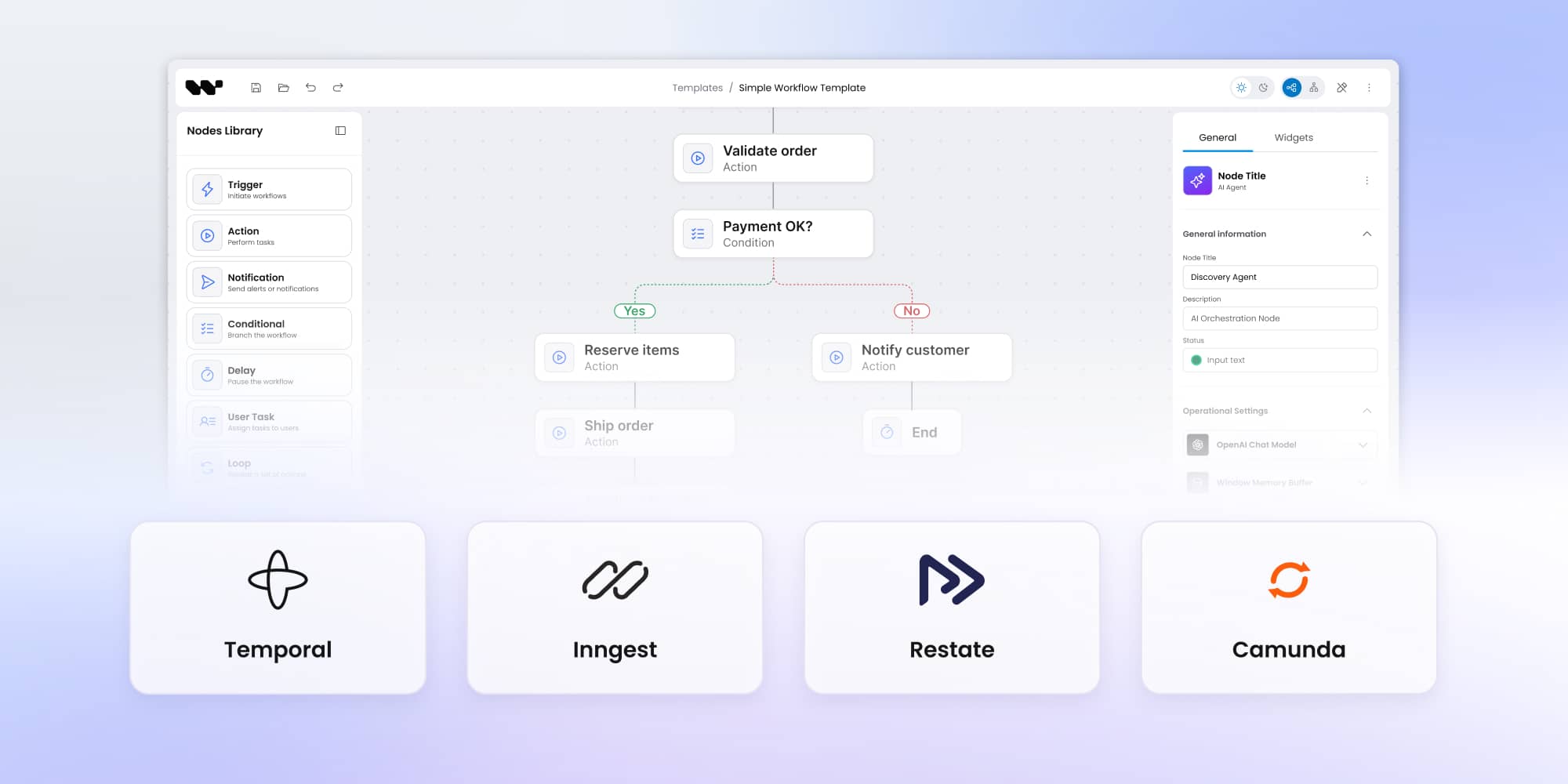
Choosing a durable execution runtime comes down to your team's operational readiness, licensing constraints, and architectural fit rather than a simple feature checklist.
- Temporal: The industry standard for heavy, mission-critical workloads (used by Stripe, Netflix) with open-source MIT licensing. Offers deterministic replay, but demands high operational investment and app re-architecture.
- Inngest: Event-driven step functions with exceptional developer experience (no local workers required) and SSPL licensing. Ideal for serverless stacks, though billed per function/step execution.
- Restate: A lightweight, single-binary runtime built for FaaS and low latency (BSL-licensed server, MIT SDKs). Simplifies stateful serverless execution without the operational footprint of Temporal.
- Camunda: BPMN-based business process orchestration for enterprises requiring strict compliance and auditability. Pairs deterministic business rules with dynamic agent boundaries, but requires commercial licensing for self-managed production.
Four different engines, one shared job: making sure a multi-step process doesn't lose its place when something fails halfway through. Where they differ isn't feature checklists – it's how much operational commitment that reliability costs you, and what kind of team is equipped to run it.
Here's how Temporal, Inngest, Restate, and Camunda compare on the things that matter once you're past the pitch deck: deployment model, licensing, pricing, and where real teams have actually hit friction.
Temporal
Model: Workflow-as-code with deterministic replay. You write workflows as regular code; Temporal persists an event history so that if a worker crashes mid-execution, it can replay events and pick up exactly where things left off.
Deployment and licensing: Temporal Service is MIT-licensed and open source, which is a real advantage over some "open available" alternatives. You're not reading fine print about when the license converts. You can self-host it, which requires real infrastructure planning (database, scaling, Kubernetes or equivalent), or run it on Temporal Cloud as a managed service. Temporal Cloud's pricing is intentionally multi-dimensional rather than a single per-execution number: plans start around $100/month for an Essentials tier and $500/month for Business, with Enterprise priced by sales. Usage is metered across several axes – workflow "actions," active and retained storage, and a support tier – with action pricing tiered downward as volume grows. It's worth budgeting for the whole shape of that pricing model, not just a headline number.
Where it's strong: Maturity and scale. Temporal runs some of the most demanding durable-execution workloads in the industry – Netflix, Stripe, Nvidia and Snap all run production systems on it. Temporal descends from Uber's Cadence, created by Temporal's founders while they were at Uber. Infrastructure practitioners describe adopting Temporal as effectively checking every box on abstracting away queues, schedulers, and distributed state machines at once – you're not assembling those primitives yourself, you're adopting a single coherent model for all of them. One fintech developer, describing the decision process before adopting Temporal, said choosing it required serious consideration precisely because it's a deep architectural commitment… but for their use case, primitives like signals, queries, updates, and the ability to version in-flight workflows justified that commitment directly.
Where it costs you: That same fintech developer was direct that Temporal is too heavy for many use cases; it's not a default choice, it's a deliberate one. Separately, developers comparing Temporal to lighter alternatives have pointed to a different kind of cost: adopting it well tends to require real re-architecture, a new SDK and sandboxing mental model for the team, and additional infrastructure to maintain, which makes incremental adoption harder than it looks from the outside. The more useful comparison question isn't "which tool has more features" – it's how much adopting a given engine forces you to reshape the application around it.
Status with Workflow Builder: Temporal is the one runtime WB ships a working adapter for today, included in the reference backend out of the box.
Inngest
Model: Event-driven step functions, designed to avoid managing your own execution infrastructure. You write functions as steps; Inngest handles retries, delays, and orchestration without standing up a cluster yourself.
Deployment and licensing: Inngest offers both a managed cloud platform and official self-hosting, expanded significantly since Inngest 1.0. The licensing is worth understanding precisely rather than assuming it's a standard permissive license: the Inngest server and CLI remain under SSPL 1.0, with a Grant of Future License that converts each version to Apache 2.0 on the third anniversary of its release. Current marketing describes it simply as "open-source and can be self-hosted," which is directionally true but glosses over the SSPL terms that apply during those first three years – worth knowing if license terms matter to your procurement process.
Pricing: The core unit is the "execution" – a durable function run, plus each individual step within it, so a function with five step.run() calls counts as six executions. The Pro plan starts around $99/month, with usage-based metering beyond that. See current Inngest pricing.
Where it's strong: Developer experience, concretely. Local development is simple – a single command starts a dev server with built-in observability and event replay, without needing Redis or separate workers just to test locally. One team's real production use case, managing video migration queues, specifically praised how much orchestration complexity Inngest hid while still leaving enough API surface to implement unusual domain-specific logic without fighting the framework; a good sign that the abstraction doesn't become a ceiling. That said, developers have also noted that despite the operational simplicity, there's still a real mental model to learn: is a given piece of logic an actor, a saga, a step function, an event consumer? The DX is smooth; the concepts underneath still take some getting used to.
Where it costs you: Less battle-tested at extreme scale than Temporal, with a smaller feature surface for the most advanced workflow patterns.
Status with Workflow Builder: Supported through the same public port architecture as Temporal, but the Inngest-specific mapping isn't distributed as a ready adapter today – pairing WB with Inngest is currently a per-project integration.
Restate
Model: Durable execution as a lightweight runtime rather than a heavyweight platform, distributed as a self-contained binary with meaningfully less operational footprint than Temporal.
Deployment and licensing: Restate's clearest practical differentiator is architectural: a single, self-contained binary with no external dependencies at the base level, alongside a managed Restate Cloud offering and, as of July 2026, a newly announced Bring-Your-Own-Cloud option. In community discussion following Restate's initial launch, the recurring question was blunt – given how mature and well-funded Temporal already is, why would anyone choose Restate instead? The honest answer centered on latency, compatibility with FaaS/serverless execution models (a push-friendly model rather than Temporal's worker-polling approach), and operational simplicity rather than any claim of feature superiority.
Pricing: Restate's own July 2026 BYOC examples illustrate capacity-based pricing – roughly $5,000 in licensing plus $1,000–2,000 in infrastructure for a workload around 500 actions/second, scaling to roughly $23,000 in licensing plus infrastructure at around 5,000 actions/second. Restate positions these figures favorably against Temporal's usage-based pricing, but that comparison is a vendor benchmark, not an independent analysis, and should be read with that caveat.
Where it's strong: Teams that want durable execution guarantees without standing up separate orchestration infrastructure, or that are building specifically for serverless/FaaS deployment models where Temporal's worker-based architecture is a less natural fit. The clearest technical distinction from Temporal, as discussed at Restate's launch, is a difference in mental model rather than just footprint: Restate treats an ongoing invocation as something the system can durably retain and reconnect to later, rather than something a request process has to keep alive itself, alongside no fixed limit on the number of state transitions a single workflow can go through.
Where it costs you: A newer, smaller ecosystem with fewer large-scale, battle-tested deployments to point to than Temporal.
Status with Workflow Builder: Same as Inngest – supported via the port architecture in principle, implemented per project rather than shipped today.
Camunda
Model: BPMN-based business process orchestration – a completely different lineage from the three code-first tools above, built around modeling processes as formal, auditable business process diagrams.
Deployment and licensing: Worth being precise here, because Camunda's model differs meaningfully from Temporal's. Self-Managed development use is free; Self-Managed production deployment requires an Enterprise license. A SaaS option is also available, hosted by Camunda, priced through sales, with a 30-day trial. Camunda 8 Self-Managed is not a freely licensed production runtime in the way Temporal's MIT license is; that's a real difference worth flagging plainly rather than assuming parity across all four tools.
Where it's strong: Organizations that already run Camunda for compliance-heavy business processes and want the same governance discipline extended to agentic workflows, rather than introducing an entirely separate, code-first orchestration paradigm alongside it. Camunda's 2025–2026 push into agentic orchestration specifically is substantive, not just marketing: the model pairs BPMN-defined deterministic process structure with AI agents operating inside defined boundaries, where the reasoning loop can be dynamic but human escalation and approval remain part of the process and execution stays fully auditable. Camunda has also added native MCP-related connectors, letting agents use external tools within a controlled process rather than an open-ended one.
Where it costs you: Less naturally suited to the highly dynamic, non-deterministic branching that AI agents often need, compared to purpose-built agent frameworks – Camunda's strength is process rigor, not agent-native flexibility. It's also worth noting directly that Camunda's agentic story today is considerably more vendor-led than community-led – independent, first-hand production retrospectives from teams running agents on Camunda are hard to find, in contrast to the abundant (if messier) community discussion around Temporal, Inngest, and Restate. That's not evidence the capability doesn't work; it's a signal that the community track record simply isn't there yet in the way it is for the other three.
Status with Workflow Builder: Same pattern as Inngest and Restate – port architecture exists, engine-specific mapping is a per-project integration today.
Even a managed engine doesn't hand you the whole application
Worth naming before the comparison table: even choosing a fully managed durable-execution platform doesn't make the "who runs the compute" question disappear. A recurring point in infrastructure discussions is that using a managed workflow engine still typically leaves you responsible for deploying and operating the workers or compute that actually execute the work – "managed" describes the orchestration control plane, not necessarily the full execution environment, and that distinction is easy to gloss over when comparing pricing pages. The same discussions make a related, broader point: a durable execution engine solves what happens after a workflow starts running – retries, state, recovery – but that's a different problem from how a customer actually builds that workflow, edits it, or watches it run. Solving the first problem well doesn't get you any closer to solving the second.
Why teams look for alternatives to the market leader
Temporal's maturity is real, but it's worth hearing directly from teams who chose not to default to it, because the reasoning is more specific than "we wanted something simpler."
One of Hatchet’s founders, who said he had used Temporal for years before starting the company, has argued that durable workflows should be one primitive among several rather than the default abstraction for every background workload. He points to tasks, events, streaming/pub/sub, concurrency controls, priorities, rate limits and scheduling as equally important building blocks, with simpler task-based execution often providing an easier entry point for engineering teams.

Their argument isn't that Temporal is wrong; it's that starting with a simpler task-based primitive can be less disruptive than requiring every workload, regardless of its actual durability needs, to adopt Temporal's execution model up front.
A related, more grounded complaint shows up in self-hosting discussions: developers who like Temporal at work have described it as too heavy for a smaller, personal, or lower-stakes self-hosted setup, and have gone looking for something lighter specifically for that context – not because Temporal underperforms, but because its operational footprint is sized for a different kind of deployment.
The pattern that emerges across these accounts is consistent: Temporal tends to be the right call when you have complex, interconnected async tasks and high reliability requirements, and can feel like overengineering when you don't yet.
What the runtime choice still doesn't solve
All four engines answer whether the process survives a crash. Camunda also gives internal users Web Modeler and Tasklist to model workflows and complete human tasks. None of these tools ships an embedded, white-label workflow canvas inside your product for your customers.
That's not a shortcoming of any of these tools – it's a separate product requirement. A product-native visual authoring layer can sit on top of whichever engine you choose, so the choice between Temporal, Inngest, Restate, and Camunda stays a durability and operations decision rather than also determining the workflow experience you can offer inside your product.
We go deeper on where that visual layer fits relative to both the runtime and the agent framework above it in our orchestration pillar.
- Which of these four is open source?
Temporal Service is MIT-licensed. Inngest's server and CLI use SSPL 1.0 with a future grant to Apache 2.0 after three years per version; its SDKs are Apache 2.0. Camunda's Self-Managed production use requires an Enterprise license – its free tier is development-only. Restate Server is BSL-licensed, while its SDKs are MIT-licensed.
- Is Temporal always the safest choice because it's the most mature?
Maturity is real, but "safest" depends on fit. Developers who've adopted Temporal for demanding, long-running, high-stakes workflows describe the commitment as worthwhile specifically because of primitives like signals, queries, and workflow versioning. The same people are often direct that Temporal is too heavy for simpler use cases that don't need that depth.
- Can I switch between these engines later without rebuilding my whole workflow layer?
That's exactly the problem an engine-agnostic visual authoring layer is designed to avoid. If your workflow definition is coupled directly to Temporal-, Inngest-, or Camunda-specific code, changing runtimes later means rebuilding that logic. A visual layer with a documented port architecture keeps the workflow definition decoupled from which engine executes it.
- Does Camunda support AI agents the same way as the other three?
Camunda's approach is architecturally different by design; BPMN-defined process structure with agent reasoning operating inside bounded steps, rather than a code-first agent framework. It's a legitimate and increasingly well-developed model, particularly for compliance-heavy organizations, but it's worth knowing the independent community track record for agentic use cases is thinner than for Temporal, Inngest, or Restate.
An entrepreneur and tech enthusiast, with over 14 years of experience building innovative diagramming solutions and tools across industries. Our interfaces help technical and non-technical users make informed business decisions.
Need more information about Workflow Builder?
Talk directly to our experts to discuss features, integration and onboarding options, or custom solutions– get clear answers for your next step.
Articles you might be interested in
.jpg)
Building a visual call flow editor for cloud telephony – and how to get it right
Every cloud telephony platform eventually hears the same request from partners: make call flow configuration visual. Here is what a good call flow editor looks like – and how to build one on Workflow Builder.
Open Source Workflow Engine Comparison: Licences, Layers and Gaps | Workflow Builder
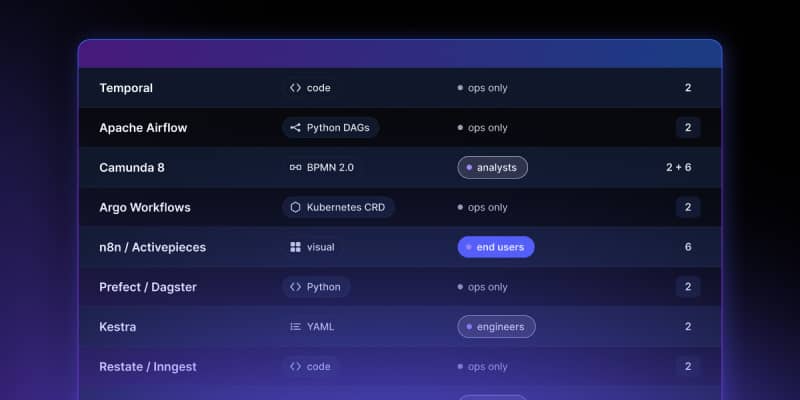
Every automated workflow runs on a stack. Most conversations about choosing an open source workflow engine collapse that stack into one question – "which workflow tool should we use" – and then stall, because the tools being compared occupy different layers and solve different problems. Apache Airflow and Camunda are both called a workflow engine. They have almost nothing in common.
Temporal Human-in-the-Loop: What the Engine Gives You, What You Build | Workflow Builder
If you're implementing human-in-the-loop (HITL) approval on Temporal, the engine gives you more than expected on the waiting problem and less than expected on the accountability problem. This article is that split, with the documentation behind each claim.