
Camunda Alternatives (and When to Pair Camunda with a Visual Layer)

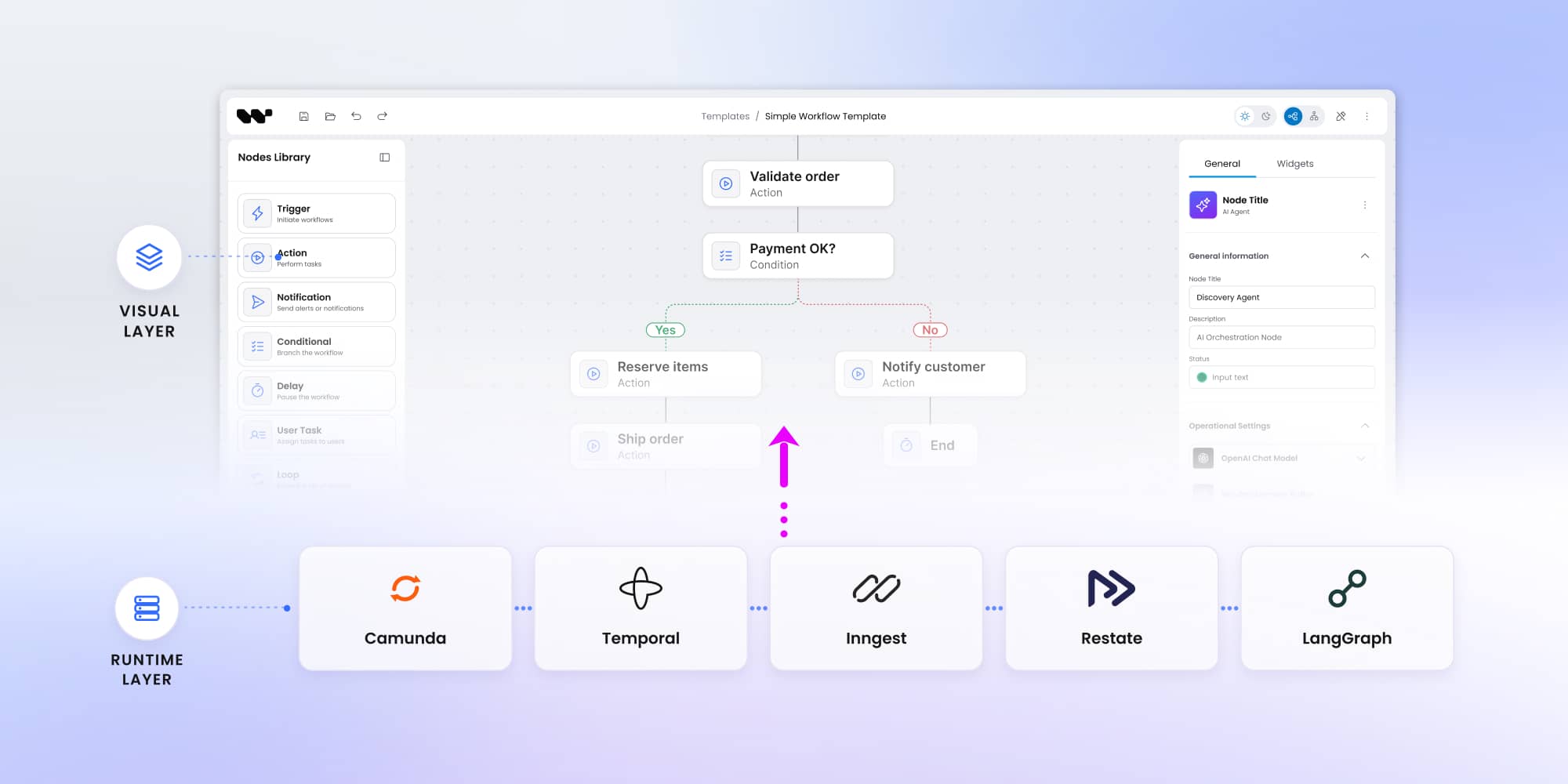
Camunda is best for governed, BPMN-based business processes involving people, systems, approvals and auditability. Temporal is the strongest workflow-as-code alternative, while Inngest suits event-driven jobs, Restate offers lightweight durable execution, and LangGraph is better for stateful AI agent orchestration. If Camunda already works well as your execution engine but users need a simpler, branded way to configure workflows, the better solution may be to keep Camunda and add a dedicated visual authoring layer rather than replace the runtime.
People searching for Camunda alternatives usually have one of two problems.
Some want a lighter, code-first runtime for long-running services or AI agents. They don't need every workflow expressed as BPMN.
Others already trust Camunda to run governed business processes, but need a safer way for product teams, operations staff or customers to see and configure those processes.
Those are different architecture decisions: one concerns the execution engine, the other concerns the authoring experience.
Camunda may be the wrong engine for the first group and the right engine with a missing interface for the second. Before comparing products, separate the runtime, agent framework and visual layer.
Our guide to AI agent orchestration explains why treating all three as one tool decision creates trouble later.
The short answer: which Camunda alternative should you choose?
Choose based on the problem your team needs to solve:
For a wider runtime comparison, see our guide to Temporal, Inngest, Restate, Camunda and the visual layer.
What is Camunda?
Camunda is a process orchestration platform built around BPMN and DMN. Its center of gravity is a modeled, end-to-end business process that connects people, software systems, decisions and now AI agents.
Camunda didn't begin as an agent framework or a developer library for background jobs. It comes from business process management, where a visible process definition, explicit handoffs and traceable execution are core requirements.
The platform's newer agentic positioning extends that model instead of discarding it. A useful way to picture it is a deterministic BPMN envelope around nondeterministic agent steps. The process can define where an agent acts, what context it receives, when a person must approve a decision and what happens if the agent fails or escalates.
That structure can be valuable. An agent might choose how to investigate a claim, for example, while BPMN still controls which records it may access, when a human reviews the result and how the case moves into payment or rejection. Camunda's platform now emphasizes the coordination of agents, people and systems with governance and a full execution trace. Its documentation also positions BPMN and DMN as the modeling foundation for those processes.
Camunda supports SaaS and Self-Managed deployment, but the licensing detail deserves attention. Camunda's current pricing page states that Self-Managed is free for local development and non-production use.
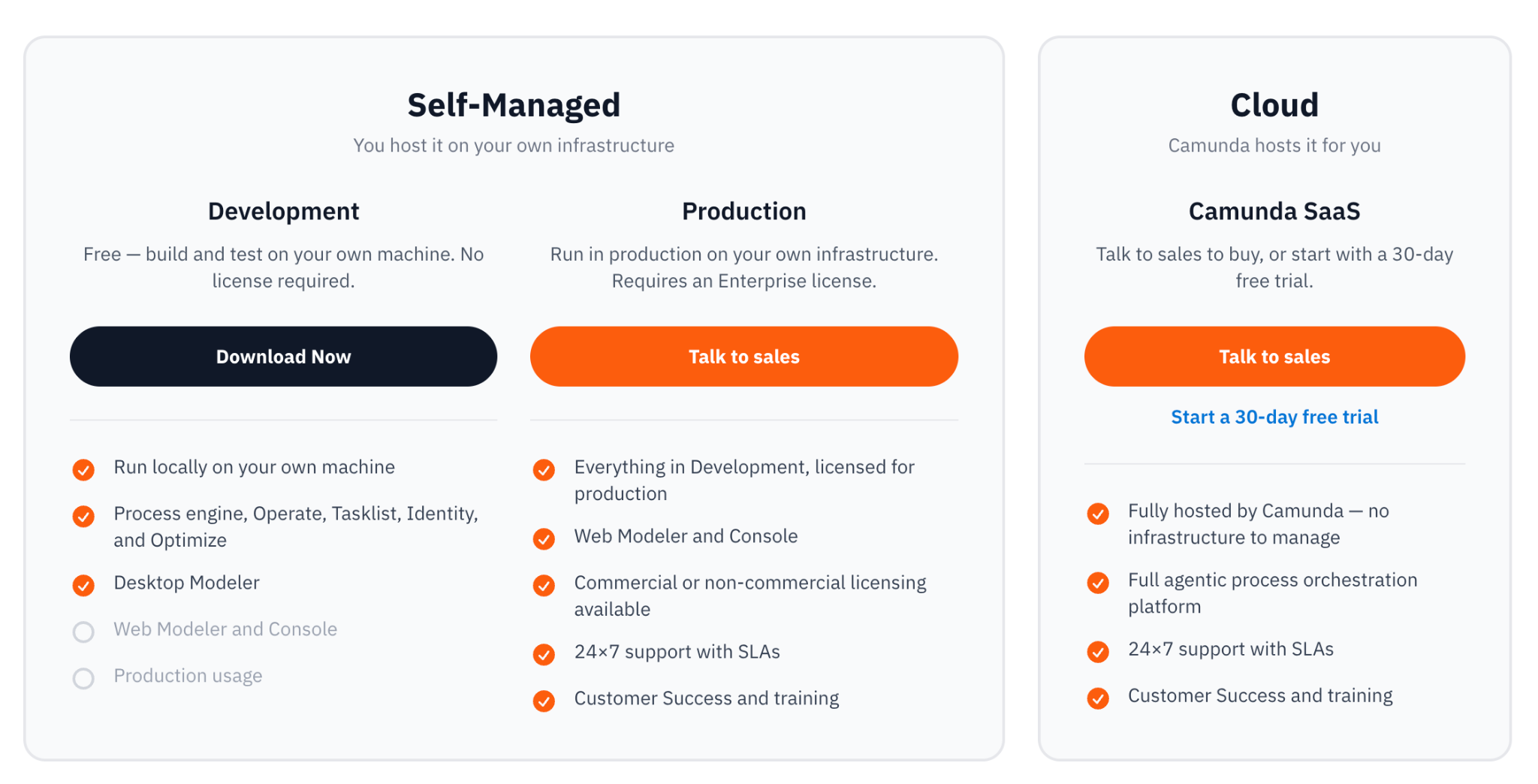
Production use requires an Enterprise Self-Managed license. SaaS comes with a 30-day trial, followed by an Enterprise plan sold through sales.
That makes Camunda different from a runtime such as Temporal, whose server is MIT-licensed and can be self-hosted in production. The comparison isn't merely BPMN versus code – it also covers procurement, hosting responsibility, operating model and long-term platform ownership.
Before evaluating engines, it helps to keep a second distinction clear: a workflow builder and a backend workflow engine solve different problems. One helps someone define a workflow, but the other makes sure it runs.
When Camunda is the right choice
Camunda remains a strong fit when the business process itself needs to be a governed asset rather than an implementation detail hidden inside application code.
#1 Your processes cross teams and systems
A loan application, insurance claim or customer onboarding process rarely belongs to one service. It can pass through identity checks, internal reviews, external providers, human tasks and exception paths. BPMN gives the organization a shared model for the complete process rather than a collection of loosely connected jobs.
#2 Auditability is a requirement
In regulated or high-risk workflows, teams may need to explain what ran, which rule applied, where an agent acted and who approved the outcome. Camunda's explicit process model and execution history suit that environment better than an informal collection of agent loops and event handlers.
#3 Business and engineering already work in BPMN
If Camunda already runs important processes, replacing it just to introduce agents can create two orchestration models, two operating practices and another governance boundary. Extending the existing process discipline may be simpler than moving agentic work into a separate code-first stack.
#4 Human work is part of the process, not an exception
Some workflows aren't meant to become fully autonomous. Review, approval, escalation and correction are normal stages. Camunda models those stages directly, which makes it a natural choice when human participation must remain visible and controlled.
Where Camunda is less natural
Camunda can be more platform than a product team needs. If workflows live mainly inside application code, developers own every change and formal BPMN governance adds little value, a code-first runtime may fit the team's habits better.
It may also feel heavy for event-driven background work, small agent services or serverless functions. In those cases, teams can end up maintaining a process platform when their real requirement is reliable retries, durable state and resumption after failure.
It’s worth taking a look at the licensing model, too. Teams that need a permissively licensed, self-hosted production runtime may prefer an MIT or Apache-licensed core. However, others may accept a commercial platform in exchange for modeling, operations and enterprise governance capabilities.
If the real requirement is an interface customers can use inside a SaaS product, changing engines won't necessarily solve it. Camunda Modeler serves process modeling. Operate and Tasklist serve operations and human work. None automatically becomes a white-label, domain-specific editor embedded in your React product.
With those boundaries in mind, four alternatives stand out.
Best alternatives to Camunda
1. Temporal: best for durable workflow-as-code
Temporal is the clearest Camunda alternative for engineering teams that want reliable, long-running workflows expressed in normal programming languages. It records workflow history and uses deterministic replay so an execution can recover after a process, worker or infrastructure failure.
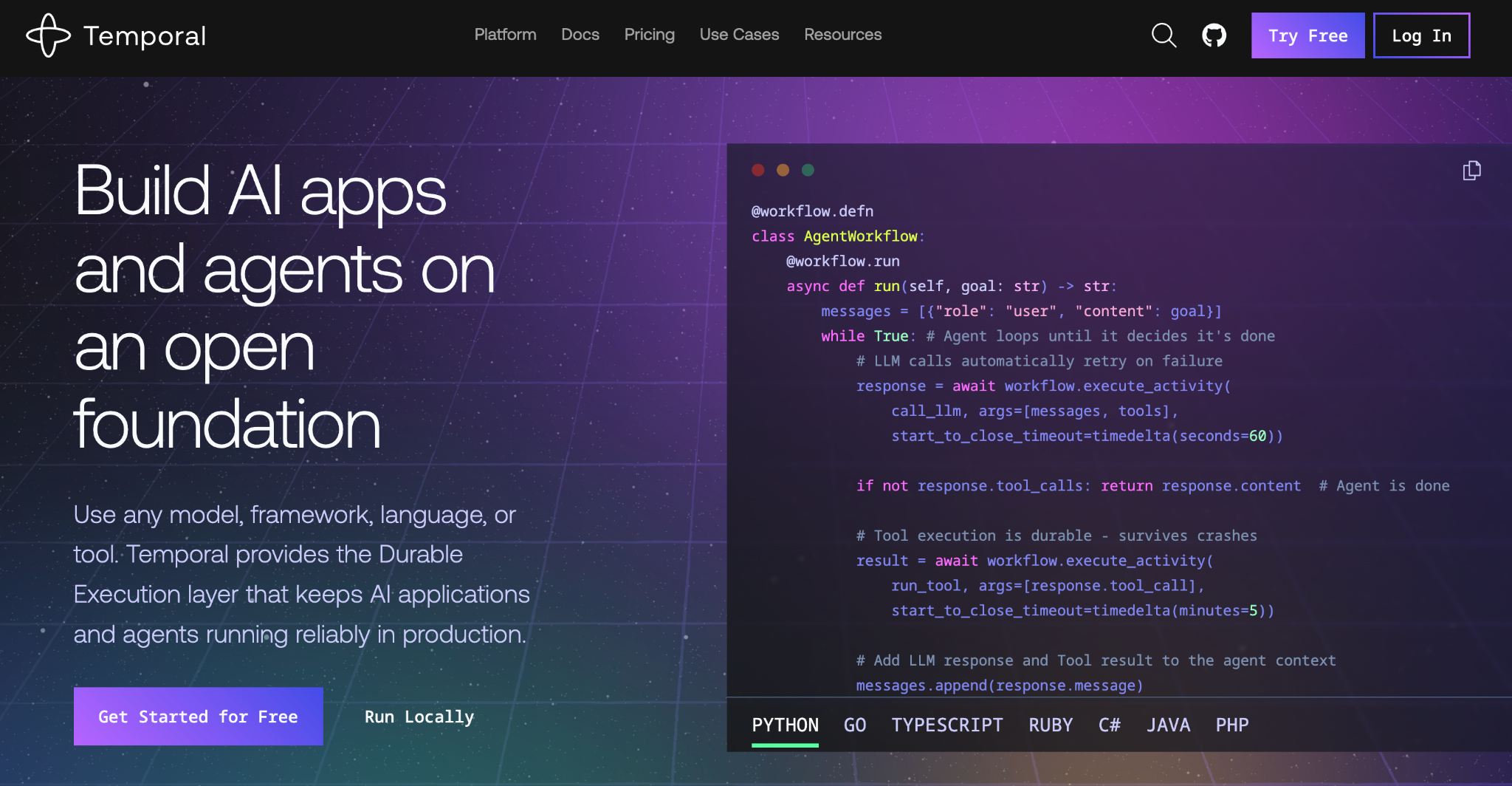
Temporal fits payment flows, provisioning, order lifecycles and agent jobs that may wait for hours or months. Signals, queries, updates, timers, retries and workflow versioning give developers strong primitives for stateful application logic.
The tradeoff is commitment. Teams must learn Temporal's programming model, respect deterministic workflow constraints and operate the service or adopt Temporal Cloud. It can be excessive for a handful of background jobs. For systems where reliable execution is part of the product's foundation, that weight may be justified.
Choose Temporal when:
- developers should own workflows in code
- executions must survive failures and long waits
- BPMN collaboration isn't a central requirement
- an MIT-licensed self-hosted runtime matters
Workflow Builder's reference backend currently ships with Temporal as its production adapter. See why Temporal became the default execution engine and the dedicated visual editor for Temporal workflows for the full architecture.
2. Inngest: best for event-driven work with less infrastructure
Inngest is an event-driven durable execution platform. Functions run on your compute and can start from events, cron schedules or direct invocation. Inngest handles queueing, retries, concurrency, throttling and step state behind the scenes.
Its appeal is developer experience. A team can build scheduled jobs, webhooks, media-processing pipelines or multi-step background functions without standing up a separate queue and worker system. Local tooling also makes it easy to inspect events and replay functions during development.
Inngest is a stronger Camunda alternative when the workflow is an application concern rather than a formal business process. It gives developers durable steps without asking business teams to model BPMN. The reverse is also true: it doesn't replace Camunda's process governance or shared enterprise modeling.
Choose Inngest when:
- workflows begin with application events
- the team wants managed durability with little infrastructure
- TypeScript, Python or Go functions are the natural authoring model
- formal BPMN and business-owned process diagrams would add overhead
3. Restate: best for lightweight durable services
Restate brings durable execution to services and regular application code. Its server is a single Rust binary with built-in persistence and messaging. Services can still run in containers, Kubernetes, serverless functions or any environment that accepts HTTP.
That deployment model makes Restate attractive to teams that want durable calls, retries, state and workflows without adopting a larger process platform. It can suspend waiting serverless workflows and reconnect callers to long-running invocations, which fits interactive services and agent tasks as well as conventional background work.
Restate isn't a BPMN suite. It won't give process owners Camunda's modeling language, task management and governance model. It focuses on making distributed application behavior reliable with a relatively small operational footprint.
Choose Restate when:
- the team wants durable execution close to its service code
- a compact, self-hosted server is appealing
- workloads span services, workflows or FaaS
- business process modeling isn't required
4. LangGraph: best for explicit agent state
LangGraph often appears in Camunda comparisons, but it isn't a direct substitute. It is an orchestration runtime for stateful agents, with persistence, durable execution, streaming and human-in-the-loop controls.
LangGraph fits systems where the central object is an agent state graph. Nodes can call models or tools, edges route execution and checkpoints preserve state. Interrupts can pause a graph for external input and resume it later.
That model gives AI engineers fine control over loops, branching and state transitions. It doesn't provide Camunda's broader business process platform or BPMN governance. A company may even use LangGraph for agent reasoning inside a larger process controlled elsewhere.
Choose LangGraph when:
- the hard problem is agent state and routing
- engineers want explicit control over agent loops
- checkpointing and human intervention are needed
- BPMN-level enterprise process management isn't the goal
Our LangGraph Studio guide covers the boundary between an agent runtime, its developer tooling and a visual authoring layer.
The third option: keep Camunda and add a visual layer
Replacing Camunda isn't always the answer. If the engine already runs reliable, governed processes, the missing piece may be a product-specific interface for the people who need to configure them.
Imagine a claims platform. Engineers may be comfortable maintaining Camunda workers and deployment infrastructure. Claims managers, however, shouldn't have to edit a generic BPMN model full of technical service tasks. They need an editor that uses their vocabulary, exposes approved node types, follows the product's permissions and prevents invalid configurations.
That is a separate layer:
- Visual authoring layer: the canvas, properties panels, validation and domain-specific nodes users interact with.
- Reference backend: APIs, persistence, execution events and translation boundaries.
- Execution engine: Camunda runs the process and preserves its operational semantics.
The visual layer shouldn't pretend to replace the engine. It should produce a controlled workflow definition and map it into the runtime through an explicit contract. Our article on why AI platforms need visual orchestration layers explains the UX problem in more detail.
Workflow Builder provides the visual authoring layer and an engine-agnostic reference backend. Pairing it with Camunda follows the same public port architecture used by the shipped Temporal adapter. The Camunda-specific mapping is implemented per project rather than distributed as a ready-made adapter.
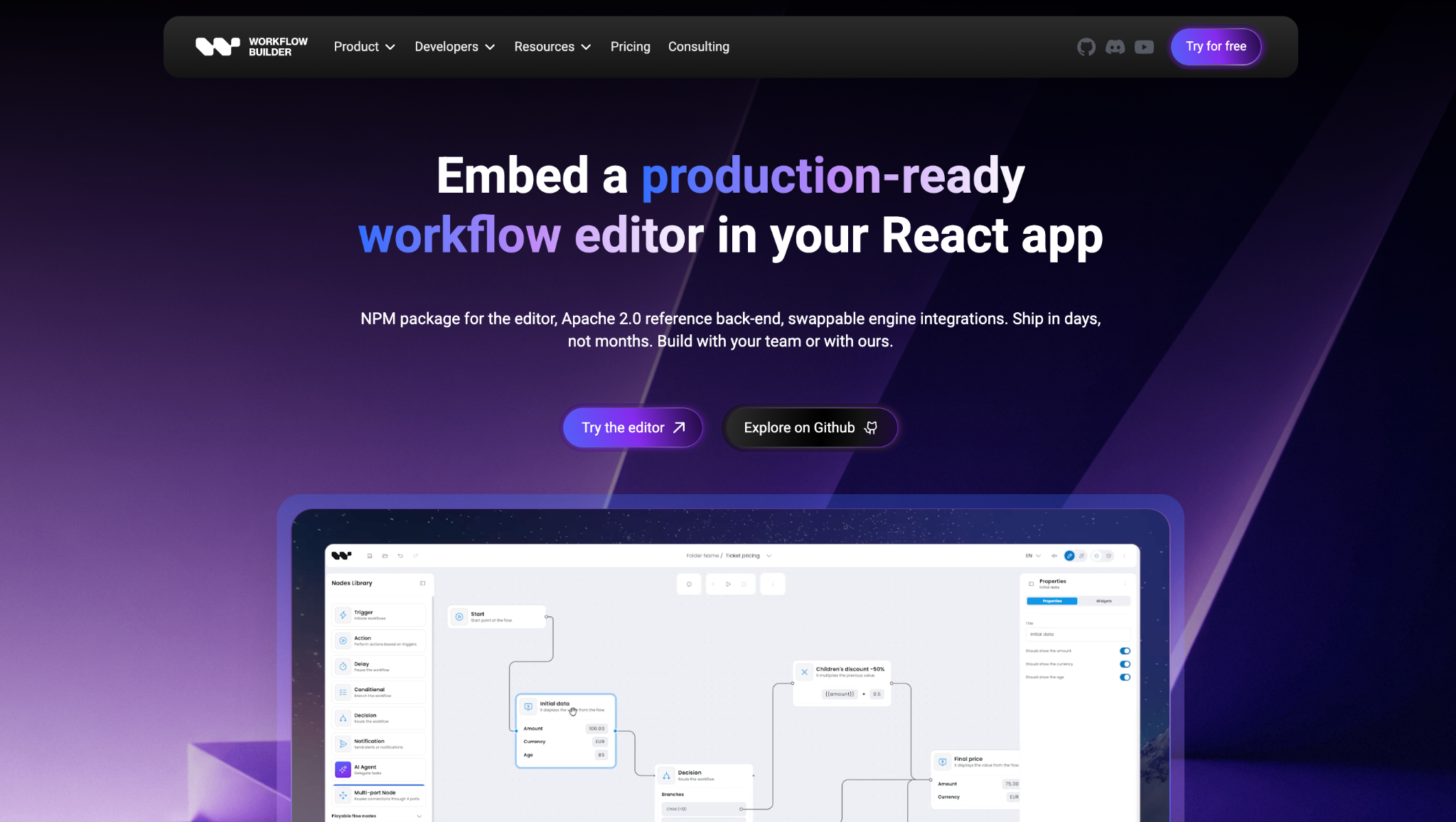
Workflow Builder supplies an embeddable visual layer for code-first AI workflows, while the project-specific adapter translates start, cancel, status and event semantics for Camunda.
The public reference stack and its three engine ports show where that mapping lives. A team can implement it internally or scope it as an integration engagement.
Camunda vs Temporal: the decision most teams are really making
The supporting question “Camunda vs Temporal” deserves a direct answer.
Choose Camunda when the workflow is a governed business process that must remain legible across engineering, operations, compliance and human participants.
Choose Temporal when the workflow is durable application logic that developers want to own and test as code.
Both can run long-lived, failure-resistant processes. Their differences start with authorship and governance:
The last row is easy to miss. Switching from Camunda to Temporal changes the runtime model, but it still doesn't create the branded workflow editor your customers or operations team need.
How to evaluate Camunda alternatives
Use architecture questions before feature checklists:
- Who authors the workflow? Developers, process analysts, internal operators or product customers?
- What must survive failure? A background job, a months-long business process or a stateful agent conversation?
- Where does governance live? In BPMN, application code, policies around the runtime or a combination?
- How much operational weight can the team carry? A managed service, a cluster, a single binary or no new runtime infrastructure?
- What does production licensing permit? Development access and production rights aren't always the same.
- Does the team need a runtime or an editor? Buying another engine won't close an authoring UX gap.
Final verdict
There is no universal best Camunda alternative.
Temporal is the strongest option for mature workflow-as-code. Inngest lowers the barrier for event-driven functions. Restate offers a compact durable execution model. LangGraph gives agent teams explicit control over state and loops. Camunda remains compelling when BPMN, governance, human work and auditability define the problem.
If Camunda already works as the engine, replacing it may introduce risk without improving the user experience. In that case, evaluate the visual layer as its own product decision.
Before committing an engineering team to a custom canvas, review the hidden cost of building a workflow editor in-house. It will help you compare a custom build with an embeddable SDK and a project-specific Camunda mapping.
An entrepreneur and tech enthusiast, with over 14 years of experience building innovative diagramming solutions and tools across industries. Our interfaces help technical and non-technical users make informed business decisions.
Need more information about Workflow Builder?
Talk directly to our experts to discuss features, integration and onboarding options, or custom solutions– get clear answers for your next step.
Articles you might be interested in
.jpg)
Building a visual call flow editor for cloud telephony – and how to get it right
Every cloud telephony platform eventually hears the same request from partners: make call flow configuration visual. Here is what a good call flow editor looks like – and how to build one on Workflow Builder.
Open Source Workflow Engine Comparison: Licences, Layers and Gaps | Workflow Builder
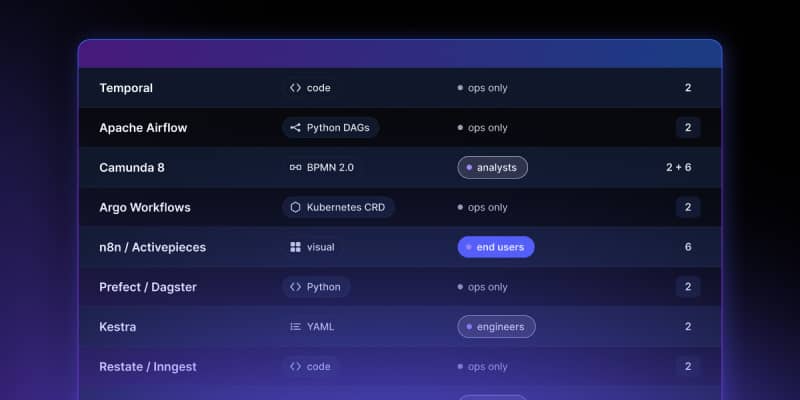
Every automated workflow runs on a stack. Most conversations about choosing an open source workflow engine collapse that stack into one question – "which workflow tool should we use" – and then stall, because the tools being compared occupy different layers and solve different problems. Apache Airflow and Camunda are both called a workflow engine. They have almost nothing in common.
Temporal Human-in-the-Loop: What the Engine Gives You, What You Build | Workflow Builder
If you're implementing human-in-the-loop (HITL) approval on Temporal, the engine gives you more than expected on the waiting problem and less than expected on the accountability problem. This article is that split, with the documentation behind each claim.